
SolveOut: The End-to-End AI SDR Outreach Platform
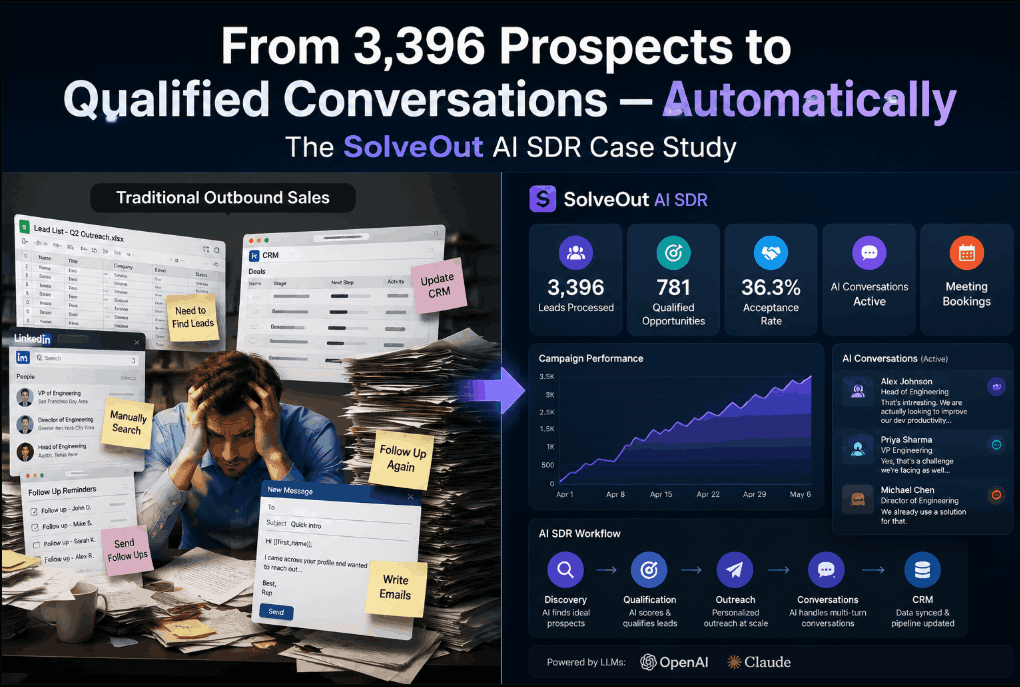
For years, outbound sales has followed the same pattern:
- 1. Buy lead lists.
- 2. Export spreadsheets.
- 3. Filter contacts manually.
- 4. Send outreach campaigns.
- 5. Follow up endlessly.
- 6. Update CRM records manually.
The process is repetitive, expensive, and difficult to scale. Most sales teams spend more time managing data than actually speaking with qualified prospects.
What if an AI SDR could manage the entire outbound process from prospect discovery to meeting qualification?
The result is SolveOut, a complete AI-powered sales development platform designed to automate prospecting, qualification, outreach, follow-ups, and pipeline management.
The Problem with Traditional Outbound Sales
Most outreach tools solve only one piece of the puzzle.
- 1. One tool finds leads.
- 2. Another enriches contact information.
- 3. A third tool sends messages.
- 4. A CRM tracks conversations.
- 5. Analytics live somewhere else.
The result is a fragmented workflow that creates operational complexity and slows down growth. Sales teams become operators of software instead of builders of relationships.
SolveOut was designed to unify the entire outbound workflow into a single intelligent system.
Meet SolveOut
SolveOut functions as a fully autonomous AI SDR.
Instead of uploading lead lists, users simply describe:
- 1. Their product or service.
- 2. Their target market.
- 3. Their ideal customer profile.
- 4. Preferred company size.
- 5. Industry focus.
- 6. Geographic regions.
- 7. Decision-maker roles.
Find VPs of Engineering and CTOs at SaaS companies with 50–500 employees across North America.
Once the campaign is launched, SolveOut takes over. The platform discovers prospects, qualifies them, initiates conversations, manages follow-ups, and tracks engagement automatically.
Everything is managed through a centralized Django-powered CRM and operations dashboard.
How SolveOut Works
1. Autonomous Lead Discovery
Traditional prospecting begins with lead lists. SolveOut begins with intent.
The platform generates intelligent search strategies based on campaign requirements and discovers relevant prospects across professional networks and public sources.
Rather than relying on static databases, SolveOut continuously expands its search space to uncover new opportunities.
2. AI-Powered ICP Matching
Finding prospects is easy. Finding the right prospects is difficult.
SolveOut uses machine learning models to analyze candidate profiles and compare them against the campaign's Ideal Customer Profile.
Every interaction helps the system better understand what constitutes a qualified lead. As campaigns mature, targeting accuracy improves automatically.
3. LLM-Based Prospect Qualification
Once potential candidates are identified, large language models evaluate each profile.
The AI determines whether the prospect fits the ICP, potential business relevance, qualification confidence, and messaging context.
This intelligent filtering layer ensures that only high-quality opportunities move forward.
4. Agentic Outreach and Follow-Up
Most outreach automation stops after sending a message. SolveOut continues the conversation.
Powered by modern LLM providers including OpenAI and Claude, autonomous agents conduct personalized multi-step conversations that identify pain points, qualify buying intent, and move prospects toward meetings.
Rather than forcing sales messages, the AI behaves more like an experienced SDR conducting genuine qualification conversations.
5. Centralized CRM and Operations Dashboard
Every campaign, conversation, prospect, and qualification signal is tracked inside a Django-powered administrative platform.
Teams gain visibility into campaign performance, lead qualification status, message history, prospect activity, response tracking, and pipeline progression from a single dashboard.
Proof of Work: Campaign Results
To evaluate the platform's performance, we analyzed a recently launched outbound campaign.
| Metric | Result |
|---|---|
| Profiles Evaluated | 3,396 |
| Qualified Opportunities | 781 |
| Connection Requests Sent | 438 |
| Accepted Connections | 159 |
| Acceptance Rate | 36.3% |
| Messages Sent | 537 |
| Replies Received | 83 |
Who Is SolveOut Built For?
- B2B SaaS companies looking to generate predictable pipeline.
- Software development agencies targeting decision-makers.
- AI startups seeking scalable outbound growth.
- Consulting firms targeting niche industries.
- Revenue teams automating repetitive prospecting work.
- Founders building outbound channels without hiring large SDR teams.
Final Thoughts
This campaign is still early in its lifecycle, but the signals are already clear.
- Thousands of prospects evaluated.
- Hundreds of qualified opportunities identified.
- Strong connection acceptance rates.
- Meaningful reply rates.
- Continuous learning from every interaction.
SolveOut is not simply another outreach automation tool. It is a self-learning AI SDR ecosystem designed to discover, qualify, engage, and track prospects at scale.
Outbound sales does not need more manual effort. It needs smarter systems. That is exactly what SolveOut was built to deliver.